
Black Poodles
Overview
With so many Poodle colors, many cannot choose a favorite. However, the stunning solid black and the snowy pure white are the 2 most common Poodle colors. When it comes to a black Poodle, let's take a look at how one may be confused when the puppy is a newborn and begin to look at the genes that are involved with this color dog.
Poodles have 2 coats of hair, an outer coat (the one that you will see) and the inner coat (the one which you will usually only see when grooming).
In a study using 50 Poodles and using a microscope to study hairs, it has been found that:
70% of black poodles have a black inner coat. The remaining 30% have inner colors ranging from grey to blue.
63.7 black Poodles will have gray-aging occur (Then the coat slowly turns a grayish/white as the dog matures.
A true black Poodle is a deep ink black. The dog's outer coat will have zero blue or silver tinting and not have any white or silver guard hairs (Although a black can have graying due to aging (63.7 % of the time according to one study).
The face (skin) when shaved will be deep black, as well. A true black will not "clear" or "fade" as the dog turns from puppy to adult. Blacks will have black points and very dark brown eyes.
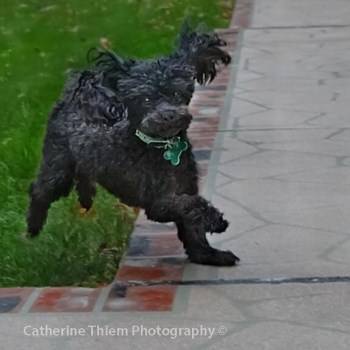
Mookie, 11 year old solid black Toy Poodle
Photo courtesy of owner: Marsha Mallis
When a Black is NOT a Black...
3 different colored Poodles can be born black. Therefore, if you have or see a black Poodle newborn puppy, one must look at the points of the dog and the pup's pedigree to determine if a change will take place.
The 3 colored Poodles that are born black are:
- Blues
- Silvers
- True Blacks
Silvers will "clear" during the first year. This means a change of color in the coat of the dog.
This involves the gradual loss of pigmentation from about 90% of the inner coat (the hairs will become transparent or white, depending on thickness), but a substantial percentage of the outer, guard hairs retain some color.
All blue Poodles are born black and then "clear" within 1 to 2 years. For this reason, many blue Poodles are registered as black. The outer coat of a blue is usually as dark as that of a black, but hairs at the root is a mix of colors. The amount of each color depends on the age
of the dog. In middle-aged dogs, medium brown predominates. True blue Poodles will have blue skin pigmentation and most have dark brown eyes.
A true black Poodle will have 3 certain enzymes that must all be present to produce black.
The first is referred to as the dark eumelanin enzyme...this is what makes hair either black or brown.
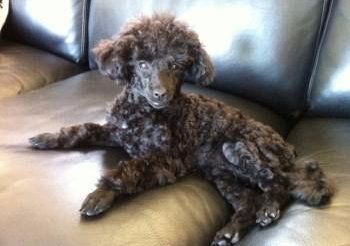
Scarlett, 18 months old
Photo courtesy of owner: Dorothy
Poodles that do not have this, will have the Pheomelanin enzyme instead, which would create a light colored coat.
So, to begin a Poodle may have the eumelanin enzyme and then in order to be a true black, there has to be two accessory enzymes that must be there as well, known as TRP1 and TRP2.
Since dogs carry genes from both parents, a Poodle with 2 black color genes has the genotype of BB.
If a Poodle has one black and one brown gene factor, the genotype is Bb; however black is dominant over brown and the coat would be black. That Poodle, however - if bred- will pass down the Bb gene, which could produce black or brown puppies, depending one which gene the other parent passes down.
Do Black Poodles have Different Behavior?
Have you heard of black dog syndrome?
It applies to all sized dogs, however tends to be used more with medium to large sized dogs, therefore it would apply to the standard Poodle more than the toy.
This is a theory that has not yet been fully proven - though informal studies have been done - that black colored dogs are passed over for adoption in favor of their lighter colored counterparts.
Some say that this is most due to media (TV shows and movies) depicting black dogs to be more aggressive or non-friendly. While it appears that some shelters have reported that dark coated or black dogs take a bit longer to adopt out, this seems to only apply to mixed breeds.
There are absolutely no temperament or behavioral differences between black Poodles and those of any other color. The coat color does not dictate a Poodle's personality, ability or socialize any other factors at all that would influence how the dog behaves.
Caring for a Black Poodle
Care elements are just about the same, there are only two minor differences:
1) Black coats will show light colored debris, just as lighter coats will show darker dirt and debris. For this reason, depending on what activities a black Poodle engages in and such things as the color fabric of carpeting in the house, etc. the coat may appear to be in need of grooming less or more often. If a black Poodle is attracting light colored lint, a quick spritz of a finishing spray will help the hairs repel fine particles.
2) As with all colors, black can lose its vibrancy over time. Elements such as long term sun exposure may cause a gradual reddening or a fading. To keep the coat as deep and deliciously black as possible, you may want to use color enhancing shampoos
that do not dye the hairs but do bring out natural color.