
Poodle Dental Care
Overview
Out of all the care tasks related to the body, dental care is the one that has the most significant impact on your Poodle's long-term health and well-being.
Of all the varieties of Poodles, miniature Poodles are the most prone to dental issues. However, all varieties including toys and standards, and all dogs breeds for that matter, are prone to dental problems. In fact, up to 80% of dogs 2 years old have some level of dental issues.
Please note:
AllPoodleInfo is reader-supported, and some of the product suggestions on this page are affiliate links. As an Amazon Associate we earn from qualifying purchases.
This is at no extra cost to you and helps us continue providing free, high-quality information.
What Happens without Preventative Dental Care
At-home dental care and professional care (as needed), is vital for all Poodles. Around-the-clock, plaque is being produced. It is a clear, sticky substance that clings to teeth. If it is not removed, within 3 days it starts to harden into tartar (also referred to as calculus), which is much more difficult to remove.
As these substances grip a dog’s teeth, they eat away at the enamel. Tartar can also travel under the gum line where it damages teeth, unseen. This often leads to tooth decay, gingivitis (gum disease), periodontal disease, and eventual tooth loss. There can also be tooth infection(s), infection that travels up into the sinuses, and the risk of full-body sepsis which can be fatal. As you can imagine, halitosis (bad breath) is common as well.
Getting Started
If you have a puppy or if your older Poodle has just had a checkup
and you were told that there are no dental issues, immediately start an at-home program of proper dental hygiene to avoid any future issues.
Note that even puppies can benefit from at-home dental care; decay on the deciduous (milk) teeth can travel to adult teeth that have not yet erupted. Another reason to start young is to have a pup become accustomed to having his teeth touched; this makes it a lot easier to do brushings once that pup matures into an adult.
If you are not sure if your Poodle’s teeth are without issues, schedule a veterinary exam. The teeth will be examined and any current issues will be resolved. Note that this may involve a ‘full dental’, which requires sedation (more info ahead on this). Then, you can implement an at-home program of proper dental hygiene to help prevent future issues.
At-home Dental Care for a Poodle
There are several methods to ensure that your Poodle's teeth stay clean and healthy.
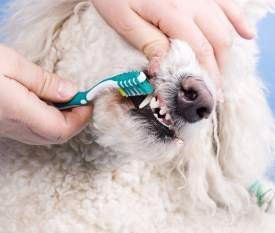
#1 Brush Your Poodle's Teeth Each Day
Brushing is the most effective method to remove plaque.
Here are some tips:
- Use an appropriately sized canine toothbrush.
- A finger-brush can work as well. This is a small, rubber-tipped doodad that slips over your pointer finger.
- Never use human toothpaste. Human toothpaste contains fluoride which is toxic to canines, possibly contains xylitol which is toxic to canines, and has foaming agents which can make a dog choke.
- Consider for a quality canine paste that is flavored to encourage tolerance to brushings; vanilla or chicken are good choices. And of course, a reputable brand will be non-foaming and non-toxic, since dogs are meant to swallow the paste.
- Brush for a good 2 to 3 minutes, once per day. If you want to do it twice, that’s all the better!
- While it is perfectly safe for a dog to swallow quality canine paste, you may wish to wipe excess paste away with a clean piece of gauze.
A slow introduction to having teeth brushed:
For puppies that are not used to this, you may wish to start slow and gradually ease into things. For the first week, set aside 10 minutes per day to have your pup sit down with you. Rub your finger all along his teeth. As you do this, use a cue phrase, such as ‘tooth time’, so that a connection can be made between the words and the actions. Give praise and reward when the session is complete. After that first week, graduate up to a finger-brush or small canine toothbrush.
For senior Poodles that may not tolerate having all of their teeth touched in this way, start off with a finger-brush; if possible, graduate up to a regular canine toothbrush after a period of adjustment.
Recommended products:
We really like the Nylabone Advanced Oral Care Puppy Dog Dental Kit ; this has an effective paste, a durable toothbrush, and a fingertip brush.
 ; this has an effective paste, a durable toothbrush, and a fingertip brush.
 #2 Or Use a Dental Spray
Though not typically effective as brushing, if your Poodle does not tolerate having their teeth brushed, you may wish to opt for a quality dental spray that is designed to loosen and remove plaque. One like Nylabone Advanced Oral Care Dog Dental Spray
 is applied by spraying it directly onto the teeth and gums and is used up to twice per day. These do work best when used on a regular basis and long-term.
 is applied by spraying it directly onto the teeth and gums and is used up to twice per day. These do work best when used on a regular basis and long-term.
 #3 Offer a Daily Dental Treat
These are specially designed edible treats that can remove a good amount of plaque due to their hard consistency and (often) their shape. Note that because these are very hard by design, it is always recommended to supervise your Poodle when they are chewing on their dental treats; this is not the sort of chew that should be given when you’re about to leave the house. If you notice that any small pieces break off from the main piece, scoop them up and toss them out.
You’ll also want to be sure to opt for a size that is appropriate for your particular Poodle and if you have a puppy, reassess things as they grow and may need to go up a size.
One of the most widely-used dental treats for dogs is GREENIES Natural Dental Dog Treats ; there are lots of options for sizing; the teenie size is for dogs 5 to 15 lbs., petite is for dogs 15 to 25 lbs., regular is for dogs 25 to 50 lbs., and large is for dogs 50 to 100 lbs. There are also flavor options including regular and blueberry, as well as a grain-free formula and a weight management formula.
 ; there are lots of options for sizing; the teenie size is for dogs 5 to 15 lbs., petite is for dogs 15 to 25 lbs., regular is for dogs 25 to 50 lbs., and large is for dogs 50 to 100 lbs. There are also flavor options including regular and blueberry, as well as a grain-free formula and a weight management formula.
 #4 Use a Dental Water Supplement, if Needed
 .
. Professional Cleanings
Even with stringent at-home cleanings and care, many Poodles also need professional cleanings every so often. And, for those that had a lack of dental care in the past, this is a ‘must’. If you have adopted a rescue or otherwise taken in an older dog, never assume that adequate dental care was done up until that point.
When a complete examination and cleaning is performed by the veterinarian, this is typically referred to as a ‘full dental’. This is usually done with a dog lightly sedated. If this is something that is being considered, your Poodle should be pre-screened to make sure that they are healthy enough for anesthesia.
The following is usually performed:
- X-rays are taken to assess the teeth and bones in the mouth and jaw.
- A flush is given to kill bacteria in the mouth.
- A dental probe is used to measure any pockets found between the teeth and gums.
- Teeth are cleaned, typically with ultrasonic scalers. Tartar is removed from both above and below the gum line.
- A special solution is applied to highlight any areas of remaining tartar, which is then removed.
- Teeth are polished.
- Teeth are visually inspected for any issues or signs of disease.
- A flush is given a second time.
- A plaque-guard agent may be applied.
How often a Poodle requires a full dental cleaning varies; some do great with a cleaning every 2 to 3 years, but others that are prone to issues (and especially if at-home care is not performed) may need a cleaning every year. This is something that can be discussed with the veterinarian.
Red Flags
An abscessed tooth is the most common and most serious issue that a Poodle can have. However, there are many issues that may occur. Take your Poodle to the vet if you notice:
- Red gums
- Swollen gums
- Bleeding from the gums
- Teeth that appear to be growing crooked
- Your Poodle seems to be in pain when eating
- Extreme bad breath
- A cracked tooth
Related:
Care Tips for Poodles with Missing Teeth
- Helpful guidelines for feeding, toys, at-home care, and more for Poodles that have lost some, most, or all of their teeth.