Parti Poodles, Mismarks, Tuxedo and Ticking
Overview
While many people equate a Poodle with a solid colored dog (with white, black, red and apricot being the most popular colors), there are many more variables in regard to coat color and markings; and some of these are AKC recognized but only partially allowed into certain events.
This section will discuss:
- Partis (two colors)
- Mismarks (a type of color marking)
- Tuxedo (a certain type of two-tone)
- Ticking on the toy, miniature and standard Poodle.
Definition of a Parti Poodle
Unlike
phantom Poodles, a parti Poodle is one with a white base coat of more than 50% and a secondary color. That secondary coat color may fall anywhere on the dog.
This is one element that makes parti Poodles so interesting. No two ever look alike and many breeders take joy in the fact that having a litters of partis is akin to opening presents...you never know what you will get!
On a well-bred parti Poodle, the white should be crisp and clear and the secondary color will have clear lines without fading into the white.
While colors may blend a lot when the Poodle is a pup, there will be many changes as the Poodle matures. Final color and the element of blended vs crisp lines can be determined once the puppy has grown into adulthood.
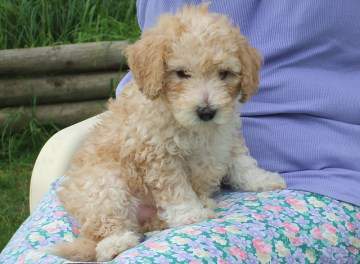
This Poodle puppy is a cream and beige parti. As the pup grows, either color may become more predominant.
It is expected that many parti Poodles will have some tiny spots, usually black, that can appear on the paws or body. However, there should not be any ticking in the white hairs. (ticking information is below)
In regard to breeding, pairing 2 partis will always produce partis, however the combinations of color and the landing areas of color cannot be predicted. One litter can contain a black and white parti and an apricot and white parti, with color falling in completely different areas.
It is the MITF gene which causes coloring
to appear in random areas in parti Poodles. Since the MITF gene is recessive to solid color (Solid color is a stronger gene), both dam and sire must be partis to create partis and a parti paired with a solid will most likely produce a solid.
Parti Poodles cannot currently be shown in AKC conformation events, and due to this some people mistakenly believe that they also cannot be AKC registered. This is not true. Partis are AKC registerable, with pre-designated color numbers, and can be shown in obedience and agility events. Many people feel that at some point in the future, they will be able to enter into conformation in the United States, as they are in other countries such as Germany.
It should be noted that partis were always very popular across the world. In the late 1900's, for unknown and unrecorded reasons, those in power decided to exclude them from the show ring. In 2002 the Multi-Color Poodle Club of American was formed and held their own conformation show in 2006, on the same day as the IKC's 12th annual premier show.
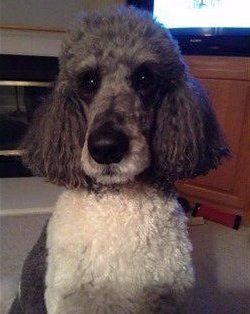
A beautiful Gray & White Parti, Standard Poodle
Mira, at 7 years old
Photo courtesy of John and Denise Haynes
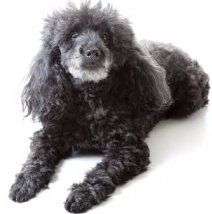
Mismark Poodles
Mismarks are also called Abstract Poodles by some breeders. A mixmark on a Poodle is considered to be a fault in regard to show conformation. Many people and even some breeders confuse mismarks with Tuxedo Poodles, or partis, believing that these words mean the same thing. This is not true. While both will have white, there is a big difference.
A mismark has less than 50% of a white coat (partis have more than 50%) and the remaining coat
may be any other Poodle color.
Essentially, a mismark is a Poodle with one main coat color other than white....and then with light markings, usually white, that is on less than 50% of the coat. The light color or white will fall on some or all of the following areas of the dog:
The chest, paws, chin, neck, tip of the tail. To further define the difference between partis and mismarks, if you were to shave down a mismark, the Poodle's skin would all be the main color of the coat. However, if you shaved down a parti Poodle, the skin would be 2 colors, showing where the white hair was and where the colored hair was.
Multi Patterned Poodles Colors
While very rare, there are Poodles with mulit color patterns. These dogs will have more than 1 of the acceptable color patterns. For example: A parti Poodle (this is 1 acceptable color pattern) with phantom markings (a secondary acceptable color pattern). These dogs are not accepted into the AKC show ring.
Tuxedo
A true tuxedo Poodle will have a very special markings in certain areas that literally remind you of a tuxedo. There will usually be:
- A white bib - this is color on the chest, it may or may not wrap all the way around the dog's neck
- A white belly - This "should" touch the bib, making a continuous white area
- White that extends from the belly down to the front and hind legs and paws.
- A darker color that covers the entire saddle (back). This does not necessarily need to be black, however that this the most typical color since red & white or blue & white tuxedo Poodles are very rare.
While this is the preferred look of a tuxedo Poodle, some will only have white that extends down the front legs, some will have a disconnection of the bib to belly, others may have white markings on the head, etc.
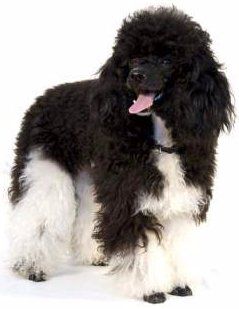
While slight spotting on the white hairs is acceptable, heavy spotting (known as ticking) is not preferred. The lines of where the two colors meet should be clear and distinct with no blending or 'muddy' lines.
Ticking
Ticking is just a term that means spotting. When a dog such as the Poodle has ticking, these are very small dots.
This usually occurs on white or light hair with the ticking (or spotting) being a dark color such as black. The gene that causes ticking is very dominant, therefore many breeders feel that Poodles that are ticked should not be used to breed partis, as the ticking can cause a rather muddied, dirty appearance that gets in the way of what would otherwise be a clear, crisp, clean looking coat.